Basic Insights23.06.2025
Defensive Publication or Patent? Evaluate!
Updated on 23.06.2025
6 min read
Updated on 23.06.2025
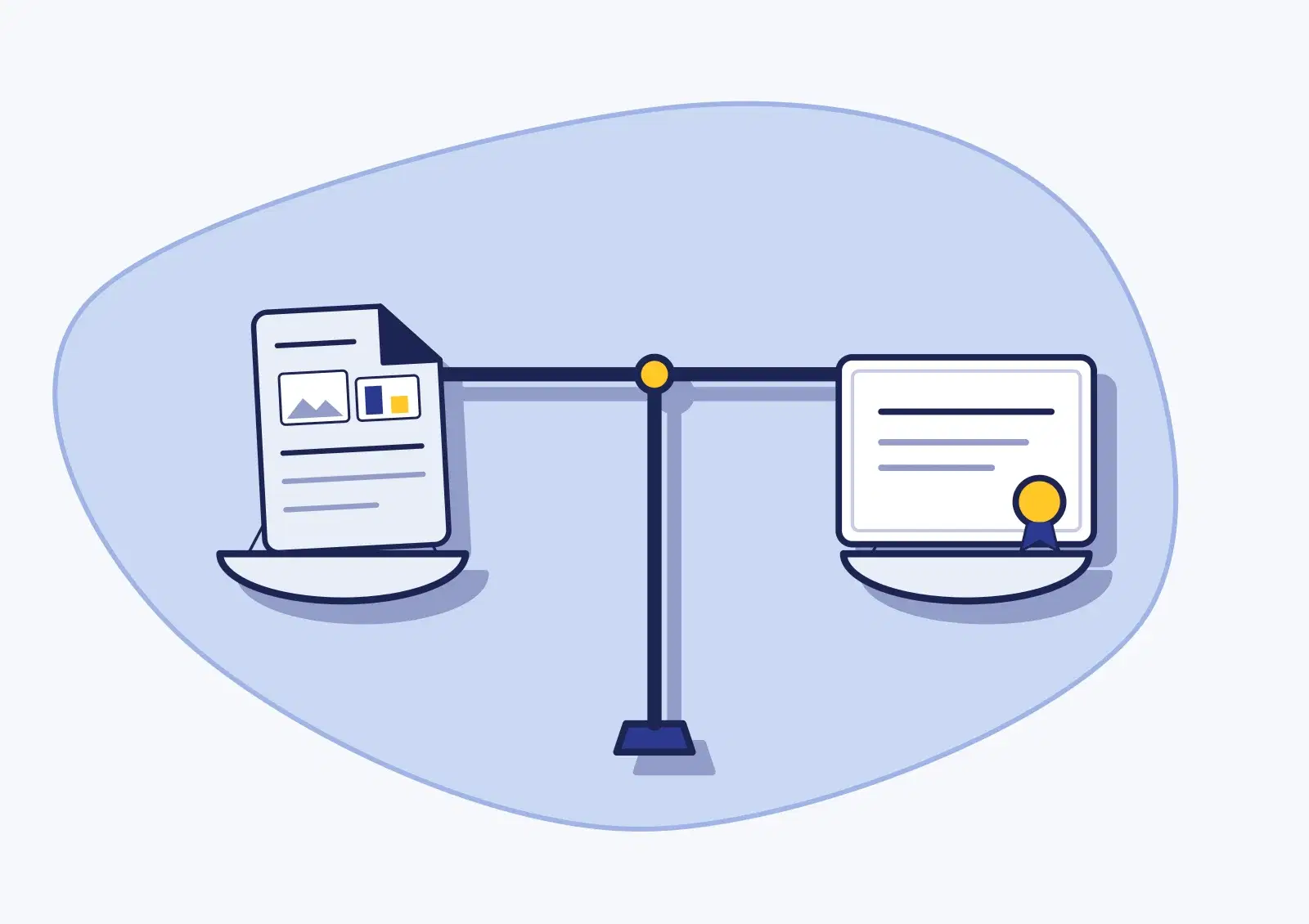
Innovators often face the question: Should I file a patent application or publish defensively? Granted patents confer exclusive rights, whereas defensive publications are an instrument to establish technical ideas as prior art, which can stand against third parties patenting the same idea.
This question arises particularly when the value of an invention appears limited. In such cases, the effort to obtain a patent can sometimes be uneconomical.
In this post, we explain when a defensive publication can be an option.
A defensive publication is a formal, public disclosure. After the correct disclosure of a document, its content forms part of the prior art and may stand against the novelty of later third-party patent applications.
While it does not create an exclusion right, the defensive publication aims to have the disclosed invention count as prior art. The most important aspects for this are:
| Aspect | Defensive Publication | Patent Application |
|---|---|---|
| Purpose | Passive protection: may stand against the patentability of the same invention by others by establishing prior art | Active protection: grants commercial and national exclusive rights |
| Cost | A few hundred euros depending on the platform | Multiple cost items per country: official fees, attorney fees, legal costs until grant, and annual fees |
| Effect | No enforceable right; serves to establish prior art and may stand against patenting of the same invention by third parties | Exclusive and regional exclusion rights; third parties can be prohibited from offering, selling, and producing |
| Enforceability | Not enforceable, as a defensive publication is not an exclusion right | Enforceable in court; injunctions and damage claims are possible |
| Publication | Immediate; avoids intermediate literature gaps | Typically published 18 months after the filing date |
| Effectiveness as Prior Art | Immediate | Fully effective only upon publication |
| International Scope | Worldwide | Protection in selected national/regional jurisdictions per granted patent only |
| Confidentiality | Not possible; limited access (e.g. paywall) is allowed | Possible via non-publication > but no prior art |
| Strategic Use | Preserving future diversification opportunities; may stand against later patenting by third parties | Protecting inventions with clear scope of protection |
| Suitability | Fast, low-cost, and ideal as a supplement or substitute | Resource-intensive per jurisdiction and time-consuming |
| Service Providers | Online platforms like Proofbox, IP.com, or Questel | Patent law firms and patent offices |
A defensive publication can be particularly useful when:
Some innovators consider secrecy. This carries risks: if a competitor independently develops the same solution, you may lose your freedom to operate. Defensive publication can help in this regard by making the disclosure prior art.
Notably, a defensive publication has an effective impact on freedom to operate (FTO).
If your goal is to preserve your invention for further use, a defensive publication can serve this purpose. The difference lies — beyond the effect — in the costs incurred and the effort required.
It is essential that the core idea of an invention is clearly disclosed and technically comprehensible for a skilled person. To support effectiveness, your disclosure should meet basic criteria:
Use platforms like Proofbox to procedurally fulfill these requirements.
In some cases, a combination is effective:
Defensive publication enables you to establish technical ideas as prior art. For many teams, this measure is a way to support freedom to operate, especially when patents are not central.
Try Defensive Publishing with Proofbox and experience how easy it is to disclose your idea globally accessible yet discreetly.
The information provided in this blog and on this page is for general informational purposes only and does not constitute legal advice. Proofbox or Proofbox GmbH is not a law firm and is not authorized to provide legal counsel or act as a legal representative in any jurisdiction. The content herein is not intended to replace professional legal consultation, and users are strongly advised to seek independent legal advice from a qualified attorney before making any decisions related to intellectual property, defensive disclosures, or publication strategies. While we aim to keep the information up to date and accurate, no guarantee is given as to the completeness, accuracy, or currentness of the content provided. Proofbox expressly disclaims any liability for errors, omissions, or outdated references and assumes no responsibility for any actions taken or not taken based on the information on this page and any pages of our Website and Blog. Using this site does not create any form of attorney-client relationship, and Proofbox assumes no legal liability for reliance on the materials presented. Please also refer to our Terms and Conditions and Privacy Policy, which govern the use of this website and our services.