Strategy19.03.2026
The Four Most Valuable Use Cases for Defensive Publications
Updated on 19.03.2026
7 min read

Updated on 19.03.2026
In modern IP strategy, it is about intelligently occupying room for maneuver. Defensive publication serves as a strategic extension to permanently support Freedom to Operate (FTO).
Four specific use cases have emerged where a process-compliant disclosure can make a difference.
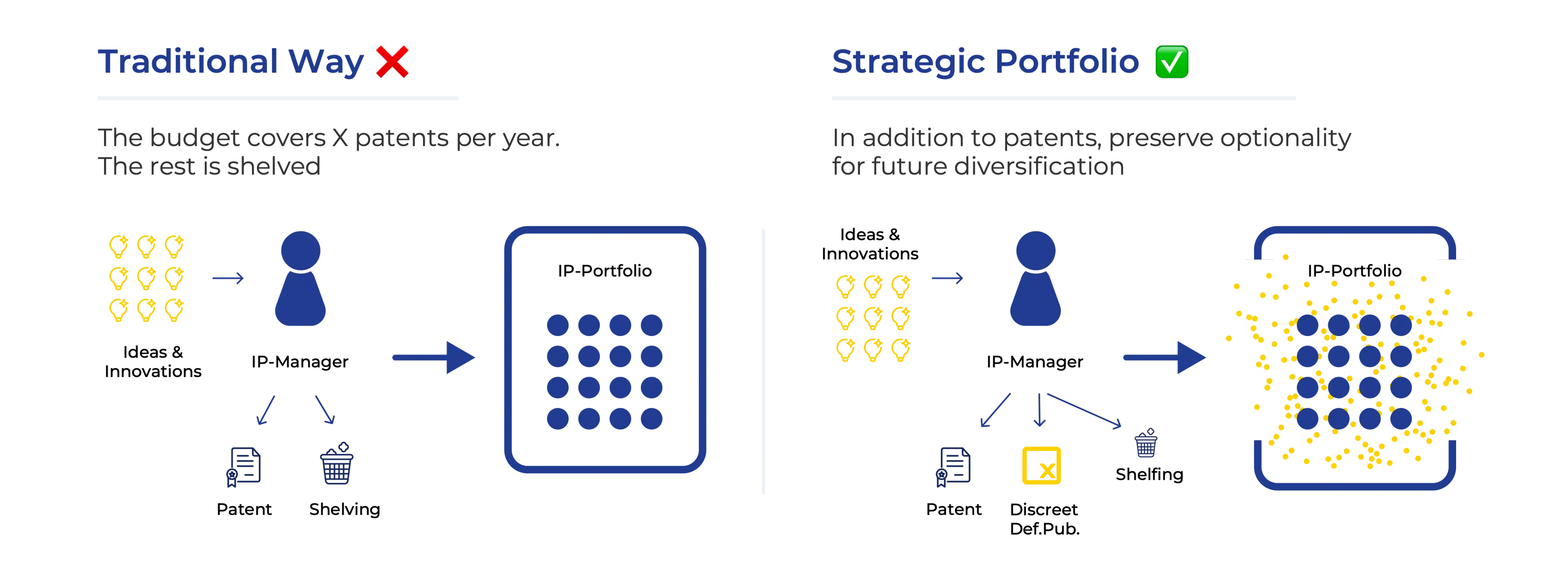
Companies often generate more invention disclosures than their budget allows for patenting. Often the decision is made to only archive the less important or currently insufficiently valuable inventions internally.
The risk: Competitors could be working on equivalent developments in parallel. If they file a patent, you may lose your freedom to operate despite having the earlier invention.
The solution: Inventions can be discreetly established as prior art. This contributes to preventing third parties from later obtaining an exclusion right for the same invention. You thus support your freedom to operate.
A trade fair appearance can constitute a disclosure. However, proving this years later can be difficult. Photos and corresponding documentation without further evidence such as witness statements or a verifiable publication date are often insufficient.
Instead of relying on vague memories and third-party witness statements, preventive documentation is an established path: publish photos and descriptions as a defensive disclosure. This creates tamper-proof evidence of prior art.
In patent law, there is the concept of internal prior use. However, proving such prior user rights is a resource-intensive hurdle. Courts usually require evidence of concrete measures toward market introduction.
The defensive publication: As a complementary measure to prior user rights, disclosure via Proofbox creates prior art. Once the innovation is published, it counts as prior art. You then have a tamper-proof document and an associated evidence protocol.
A patent application is typically published only 18 months after its filing or priority date. Particularly in the European legal framework, there are peculiarities whereby patent applications filed in the interim (i.e., after the filing or priority date and before the publication date) for the same invention need only distinguish themselves from the older right in terms of novelty (not in terms of an otherwise required inventive step).
An additional defensive publication of a previously filed patent application can be useful in this regard, as the content is established as prior art more quickly. This can further increase the value of the invention in addition to the patent application.
The information provided in this blog and on this page is for general informational purposes only and does not constitute legal advice. Proofbox or Proofbox GmbH is not a law firm and is not authorized to provide legal counsel or act as a legal representative in any jurisdiction. The content herein is not intended to replace professional legal consultation, and users are strongly advised to seek independent legal advice from a qualified attorney before making any decisions related to intellectual property, defensive disclosures, or publication strategies. While we aim to keep the information up to date and accurate, no guarantee is given as to the completeness, accuracy, or currentness of the content provided. Proofbox expressly disclaims any liability for errors, omissions, or outdated references and assumes no responsibility for any actions taken or not taken based on the information on this page and any pages of our Website and Blog. Using this site does not create any form of attorney-client relationship, and Proofbox assumes no legal liability for reliance on the materials presented. Please also refer to our Terms and Conditions and Privacy Policy, which govern the use of this website and our services.