Strategy29.06.2025
How to Optimize Your IP Budget with Strategic Disclosures
Updated on 29.06.2025
6 min read

Updated on 29.06.2025
For startups, R&D departments, and SMEs, managing the IP budget is a permanent balancing act. Filing patent applications can quickly incur high costs per country. Add to that examination procedures, translations, and annual maintenance fees.
This financial pressure often forces teams to make difficult decisions:
This is exactly where a strategic combination of patents and defensive publications comes in.
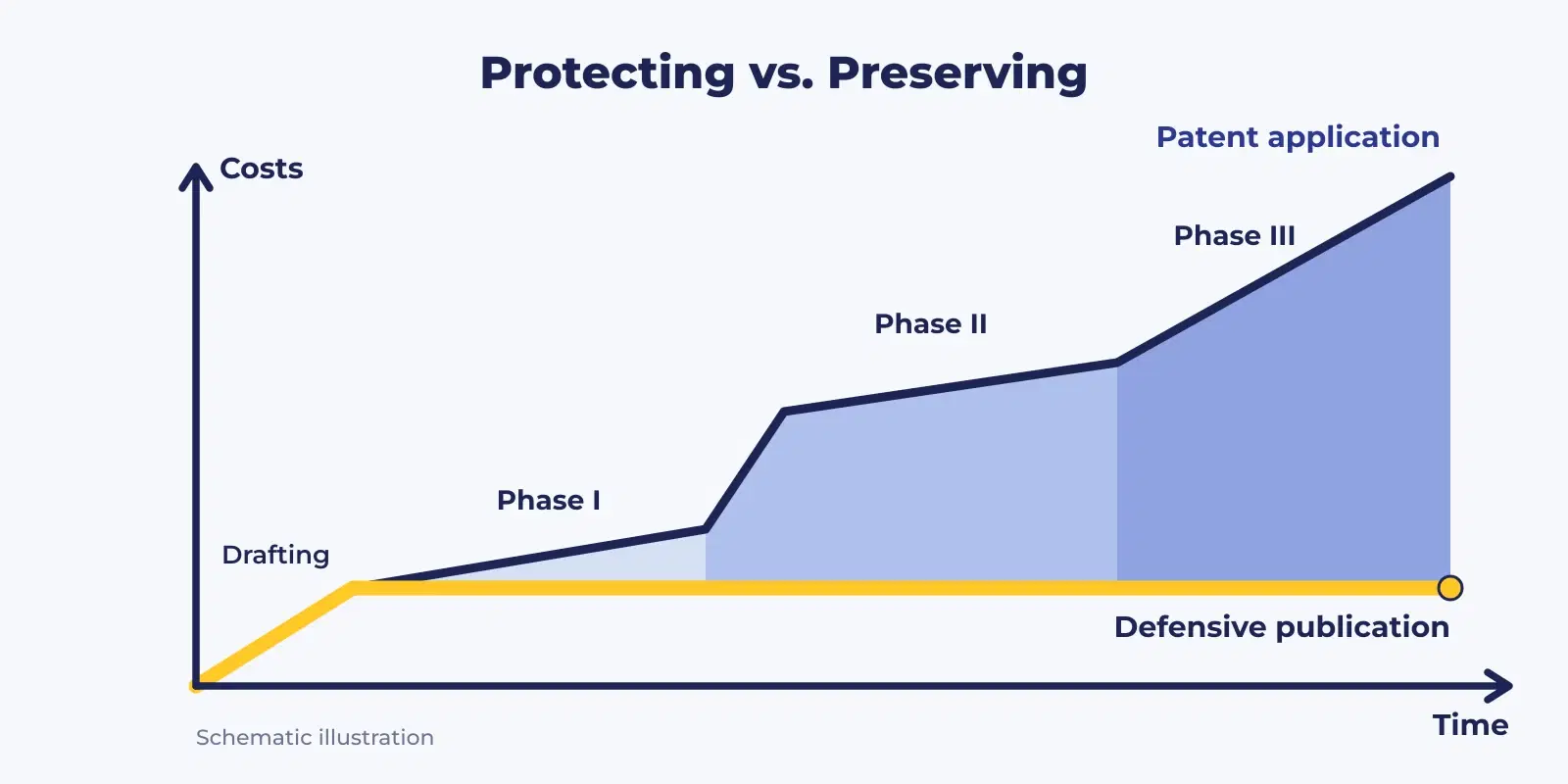
As illustrated in this schematic diagram, professional drafting can be an initial cost factor for both a patent application and a defensive publication. However, after carrying out the defensive publication, no further follow-up costs are incurred.
After drafting the patent application, Phase I begins: The application is filed, for example, at a national office. During the examination phase, official communications may need to be responded to. These steps lead to additional costs.
Since a patent is a regional exclusion right, Phase II represents the costs of extension to additional regions. Separate costs are to be expected for each country or region.
Phase III covers the ongoing costs of granted patents. These include at least national annual maintenance fees.
The traditional route of protecting an invention with a patent grants exclusion rights upon grant but comes with corresponding costs.
By contrast, preserving freedom to operate for an invention through defensive publication offers:
This makes defensive publication particularly attractive for:
A possible IP strategy does not protect everything — it preserves strategically and in addition to other measures.
Here is how you can structure your approach:
1. Prioritize patents for core technologies
Protect innovations central to your business model.
2. Use defensive publications for everything else
Disclose incremental features or variants. These serve as strategic extensions.
3. Publish early to create evidence
The earlier your disclosure is public, the more valuable the prior art created can be.
4. Efficiently reuse internal invention disclosures
With Proofbox, even a short invention report can be cost-effectively published.
5. Apply cascaded publication for evolving inventions
If an invention is later improved, a second, more detailed publication can follow. Each version receives its own timestamp, creating a traceable chain of evidence for your development.
Suppose your team develops 10 innovation concepts with respective invention disclosures this year. Patent applications for all inventions could significantly strain your budget. Instead, you could:
Result: Your entire innovation output is strategically mapped while optimizing costs.
Strategic disclosure not only saves money — it:
Especially in industries with dense prior art, defensive publication can be a strategically valuable additional measure.
It is not always necessary to file a patent application for every invention disclosure. By applying protection where it counts and creating prior art where it is strategically sensible, you get the best of both worlds.
Platforms like Proofbox help you implement this approach efficiently — with compliant timestamps, permanent archiving, and discreet publication.
Try Proofbox and publish your next disclosure process-compliant and cost-effectively.
The information provided in this blog and on this page is for general informational purposes only and does not constitute legal advice. Proofbox or Proofbox GmbH is not a law firm and is not authorized to provide legal counsel or act as a legal representative in any jurisdiction. The content herein is not intended to replace professional legal consultation, and users are strongly advised to seek independent legal advice from a qualified attorney before making any decisions related to intellectual property, defensive disclosures, or publication strategies. While we aim to keep the information up to date and accurate, no guarantee is given as to the completeness, accuracy, or currentness of the content provided. Proofbox expressly disclaims any liability for errors, omissions, or outdated references and assumes no responsibility for any actions taken or not taken based on the information on this page and any pages of our Website and Blog. Using this site does not create any form of attorney-client relationship, and Proofbox assumes no legal liability for reliance on the materials presented. Please also refer to our Terms and Conditions and Privacy Policy, which govern the use of this website and our services.