Research10.10.2026
Patented in 2002: Why Prior Art Without Evidence Does Not Count
Updated on 10.10.2026
7 min read

Updated on 10.10.2026
In short: In US patent examination, what counts as prior art is not what is known, but what is documented, as a rule by a dated, written document. What everyone knows but nobody has published is, for the purposes of examination, practically non-existent. That is why swinging sideways, a dog toy shaped like a branch and playing with a cat and a laser pointer could all be patented, as a new article by the legal scholar Jorge L. Contreras shows. This is precisely where a defensive publication comes in: it turns knowledge into a dated, public document that can be submitted as evidence.
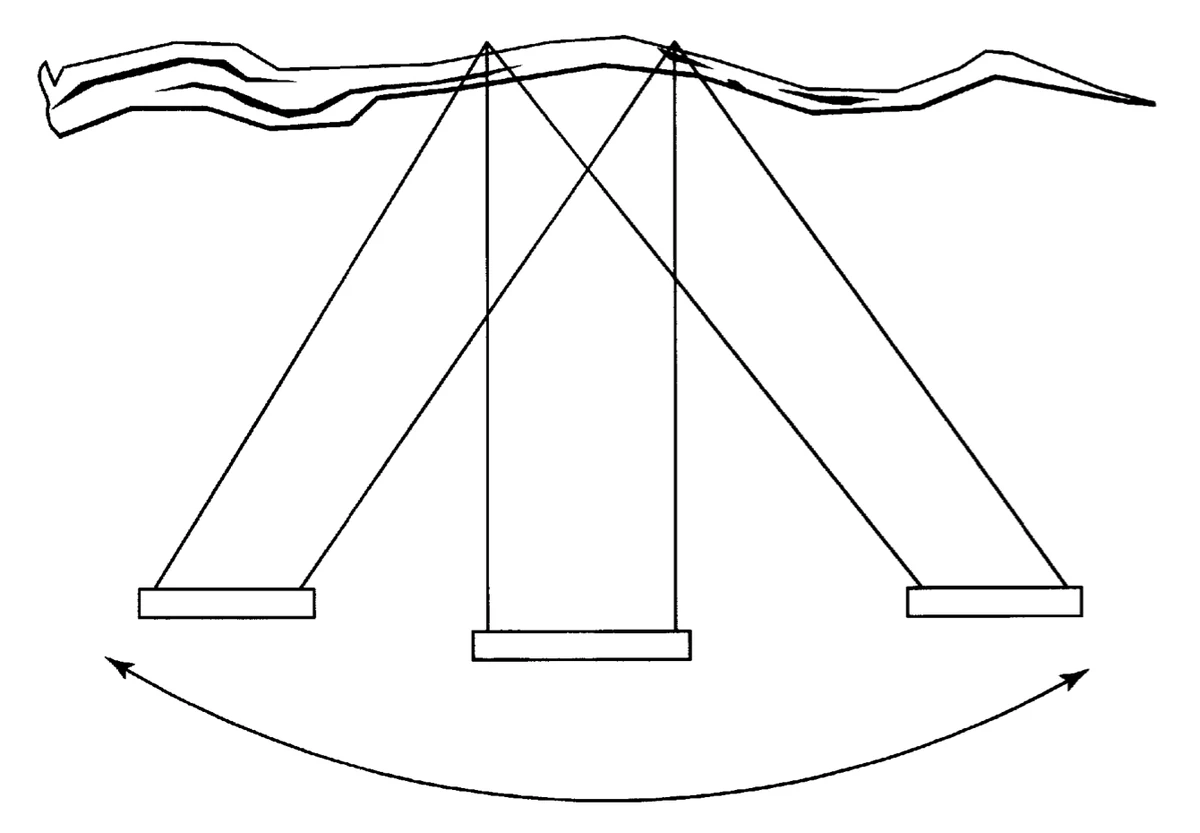
The named inventor is a five-year-old boy whose father is a patent attorney. The invention: by pulling alternately on the left and the right chain, the user sets the swing moving from side to side instead of in the usual forward and backward motion. On 9 April 2002 the US Patent and Trademark Office granted patent US 6,368,227, “Method of Swinging on a Swing”. Only one dependent claim, which combined swinging with a yell in the manner of Tarzan, failed; all other claims were allowed.
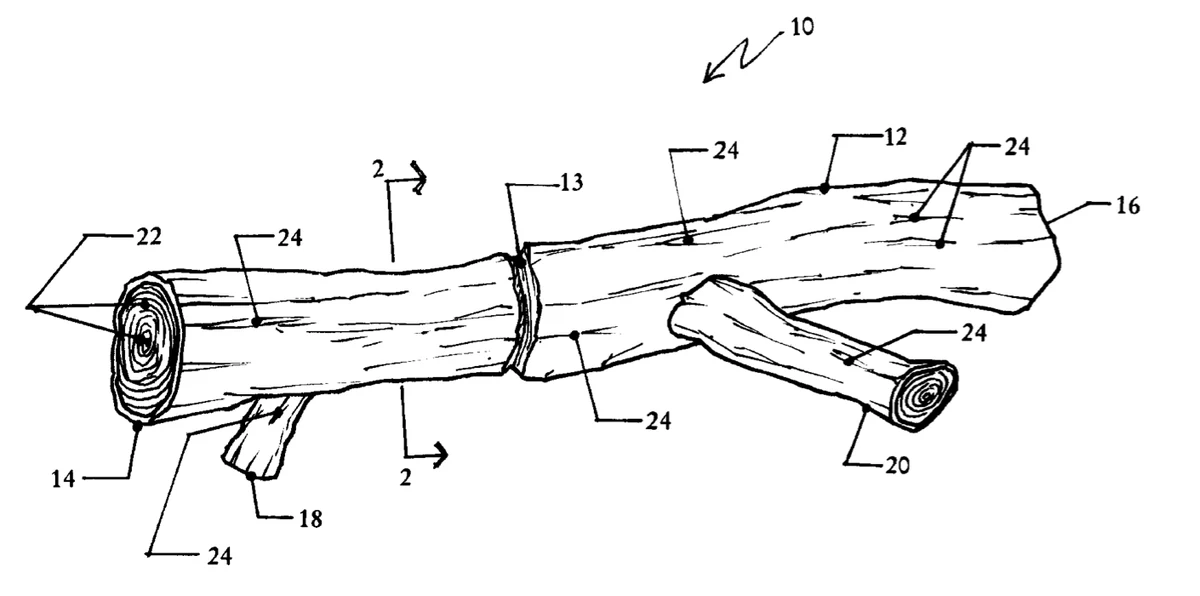
Two weeks earlier, on 26 March 2002, patent US 6,360,693 had been granted: a toy for dogs in the shape of a branch, with an elongated body and at least one lateral protrusion, buoyant so that the dog can also retrieve it from water. Contrary to frequent reports, the patent did not concern a natural stick but a manufactured article modelled on one.
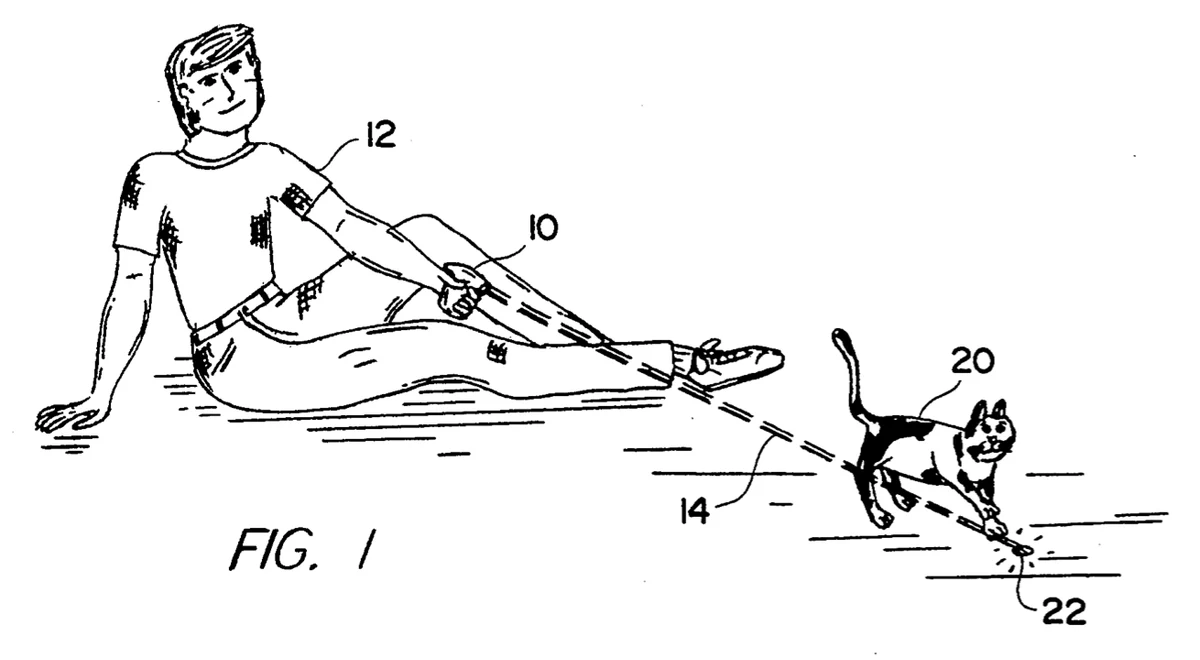
As early as 1995 the same office had granted patent US 5,443,036, a “Method of Exercising a Cat”. What was claimed was directing the beam of a laser pointer onto the floor or a wall and moving the spot of light so that the cat chases it.
Jorge L. Contreras, a law professor at the University of Utah, analysed the prosecution files of these three patents for his article “Silly Patents, Serious Issues”. His findings reach far beyond the anecdote. The issuance of such patents “cannot simply be attributed to inattention or carelessness by the PTO”, he writes; rather, it is symptomatic of serious problems with the examination system itself (p. 18). At its core lies a question that concerns every inventor: what counts as known in patent examination?
The swing. The examiner initially rejected the main claim, relying on a patent from 1881 that shows a swing with a chair-like seat hanging from three chains. The applicant then limited his claim to two chains and to a seating direction perpendicular to the branch, and a little over a week later the claim was allowable. After the ridicule in the press, the Director of the office ordered a reexamination in May 2002; in July 2003 all claims were cancelled. Contreras notes that the examiner’s experience of everyday life played no overt role in the examination (p. 23). Sideways swinging, Contreras observes, was not invented by any patentee in 1881 or later, and no patent specification taught it to children around the world (p. 24).
The dog stick. The examination dragged on for six years. The examiner first cited a chewable pull toy for dogs, then an artificial branch for aquariums. The applicant objected that the aquarium branch had to sink whereas his toy floated, and was then granted the patent. In the reexamination the examiner cited, among other things, the stalk of a living plant (“naturally-occurring objects … are considered to be manufactured by nature”), an artificial fireplace log, a training baton for the police and finally an artificial saguaro cactus up to fifty feet tall for landscaping. This too was a toy, the reasoning went, being “an amusement or diversion for humans (a type of animal) or, conceivably, their pets” (pp. 29–30). By July 2006 not a single claim remained. Contreras considers all of this avoidable: a stick-shaped dog toy made of wood is obvious, and the examiner could simply have said so (p. 32).
The cat. In this case the examiner found no relevant patent and relied instead on a scientific article from 1991. In it, cats were restrained in a wooden box and had to touch a spot of light on a screen with a paw so that the researchers could measure the effect of an antidepressant on reaction time. The applicants distinguished their invention from it step by step, first by normal lighting, then by the unrestrained cat and finally by an “invisible” beam of light. The patent was granted. Contreras looked into what was actually known at the time of filing and came across a Usenet archive from October 1991 in which at least thirty people wrote about playing with their cats using laser pointers (pp. 38–39). His conclusion: “Clearly, no patent document or scientific paper established this fact, and therefore the examiner could not rely on it. Yet it was the case.” (p. 38).
Contreras traces the three cases back to two causes.
The first is the search space. By a substantial majority, the references that examiners rely on as prior art are US patents (p. 60). Patent literature, however, only describes what someone has filed for a patent. Everyday activities such as a child on a swing, a dog with a stick or a cat chasing a red dot hardly appear in it (p. 60). According to Contreras, the same applies to entire fields such as software and business methods, in which little is patented, leaving significant gaps in the patent literature (p. 61). The non-patent literature that examiners do use consists mainly of scientific articles and technical documentation (p. 61), which rarely yield anything for everyday inventions (p. 62).
The second cause is a rule of evidence. Until 2002, US examiners were permitted to reject a claim as obvious on the basis of the common knowledge and common sense of a person skilled in the art. In In re Lee, 277 F.3d 1338, 1344 (Fed. Cir. 2002), the competent court of appeals required that such a finding be supported by “a specific reference in the written record”. In the court’s words, “deficiencies of the cited references cannot be remedied by the [PTO’s] general conclusions about what is ‘basic knowledge’ or ‘common sense’” (id. at 1344–45). Since then, the office’s examination manual permits reliance on common knowledge without documentary evidence only where the facts are “capable of instant and unquestionable demonstration as being well-known”. Contreras calls this hurdle nearly insurmountable (p. 58).
For design patents, Contreras notes, the dependence on written evidence is even more pronounced. He quotes Sarah Burstein: “someone cannot simply testify: ‘my grandma used to wear those exact pants.’ There must be corroborating documentary evidence” (n. 251, citing Burstein, Uncreative Designs, 73 Duke L.J. 1437, 1468 (2024)).
Contreras proposes reinstating common knowledge as a basis and extending the search to all available means, search engines included (pp. 59–60 and 64). Whether and when practice will change is open. Until then, the principle that the cat owners of 1991 demonstrated without meaning to applies: in examination, what counts is not what is known, but what is documented. Knowledge that is nowhere dated and publicly recorded can hardly be asserted in examination. A defensive publication is designed to close precisely this gap.
Taken to its logical conclusion, Contreras’ finding applies to every publication outside the patent literature, including a defensive publication on a website, in a journal or in an archive such as the one run by Proofbox. That such a document exists does not mean it will be found in examination. That is the very core of his argument.
What such a document can achieve is something else: it provides the written reference that In re Lee requires, and whoever knows about it can submit it themselves. Many patent systems provide ways to do so, for instance submissions of prior art by third parties in pending examination proceedings and, after grant, opposition or invalidity proceedings. The US Patent and Trademark Office itself pointed to the possibility of such third-party submissions when it discontinued an internal warning programme for conspicuous applications in 2015 (p. 56, n. 221). Whether a submitted document is taken into account as prior art in a given case is decided by the competent authority or court.
For a document to fulfil this role, three things must be provable: what it contains, since when it has existed in this version, and that it was publicly accessible.
Proofbox is designed to document these three points for every publication. Each document receives a qualified electronic seal with a qualified timestamp under the eIDAS Regulation (EU) 910/2014; the SHA-256 hash embedded in the seal makes later changes detectable, and the timestamp records the date. Each publication receives a persistent DOI and a permanent address at which title, abstract and metadata are openly findable. And the public findability of every publication is checked and logged at regular intervals; the log can be downloaded for each document individually.
Proofbox thus creates the conditions for the content, date and accessibility of a publication to be provable. Nobody can promise that an examiner will find it of their own accord. What matters is that a document exists which can be submitted when needed.
Next step: Whether a patent application or a defensive publication is the more suitable route for a development can be assessed independently with the interactive checklist. Anyone who has already described their development can publish the document directly with Proofbox.
A defensive publication does not create an industrial property right. Whether it is taken into account as prior art in a given case is decided by the competent authority or court in its free evaluation of the evidence. Proofbox provides the technical and organisational preparation, not the legal assessment.
Jorge L. Contreras, Silly Patents, Serious Issues, 17(1) U.C. Irvine Law Review (forthcoming), preprint on SSRN. This article relies on the draft dated 20 April 2026, retrieved on 9 October 2026; page references refer to that version. Later versions may differ in wording and pagination. The SSRN entry was last accessed on 10 October 2026. The patents discussed: US 6,368,227 (swing), US 6,360,693 (dog toy), US 5,443,036 (cat).
The information provided in this blog and on this page is for general informational purposes only and does not constitute legal advice. Proofbox or Proofbox GmbH is not a law firm and is not authorized to provide legal counsel or act as a legal representative in any jurisdiction. The content herein is not intended to replace professional legal consultation, and users are strongly advised to seek independent legal advice from a qualified attorney before making any decisions related to intellectual property, defensive disclosures, or publication strategies. While we aim to keep the information up to date and accurate, no guarantee is given as to the completeness, accuracy, or currentness of the content provided. Proofbox expressly disclaims any liability for errors, omissions, or outdated references and assumes no responsibility for any actions taken or not taken based on the information on this page and any pages of our Website and Blog. Using this site does not create any form of attorney-client relationship, and Proofbox assumes no legal liability for reliance on the materials presented. Please also refer to our Terms and Conditions and Privacy Policy, which govern the use of this website and our services.